See Beyond the Averages

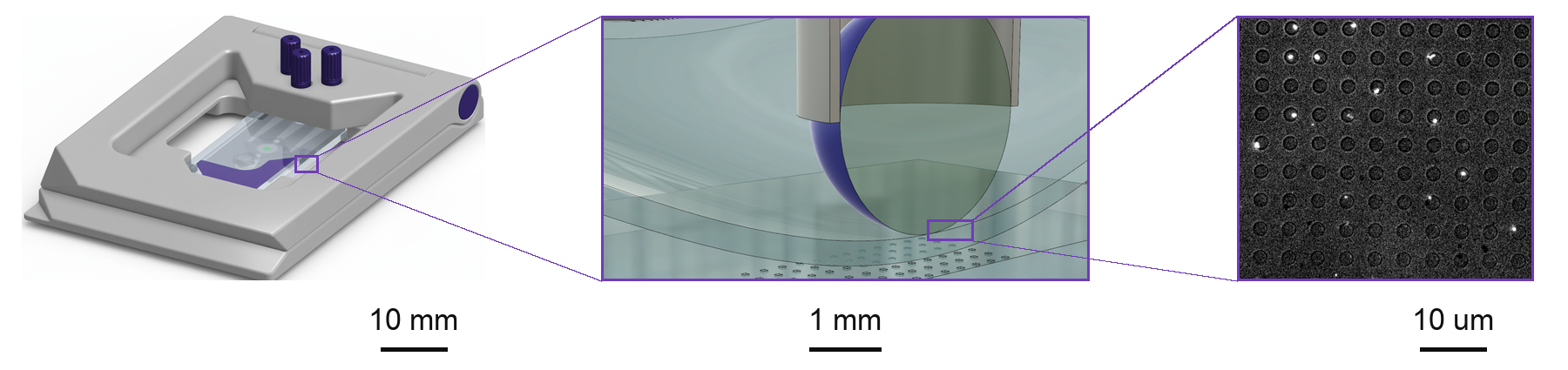
CLiC consumable, confinement mechanism, and microwell array

Interface with CLiC consumable fits on the microscope stage

Physical or pneumatic mechanism to confine biomaterial in microwells

Microwell array showing single-particle observation in solution

CLiC Platform

Convex Lens-induced Confinement (CLiC) is ScopeSys' proprietary analytics platform for observing biomolecules under biologically relevant conditions. Instead of relying on population averages, CLiC measures individual particles and molecules one at a time, generating rich, correlated datasets that reveal how complex therapeutic systems behave.

For genomic medicines, CLiC is especially powerful because researchers can move beyond basic size and encapsulation measurements to understand particle-to-particle heterogeneity, cargo loading, molecular organization, and dynamic interactions that influence important drug properties.

  • Built for complex therapeutics: Designed for multi-cargo lipid nanoparticles (LNP), mRNA-LNPs, ASO drugs, siRNA drugs, pDNA.
  • Single-particle resolution: Measures thousands of individual particles to reveal subpopulations that are hidden by bulk methods.
  • Multiparametric readouts: Links size, diffusivity, fluorescence intensity, payload presence, payload copy number, molecular organization, and interaction dynamics on the same particle.
  • Works in solution: Avoids surface tethering so particles and molecules can be observed closer to their native behavior.

How CLiC Technology Works

CLiC uses precisely controlled confinement geometry to keep freely diffusing biomaterials within the microscope focal plane for extended, high-sensitivity observation and measurements.

Load sample into the CLiC consumable

The sample is introduced into a microfluidic flow cell containing patterned confinement regions or microwells.

Apply controlled confinement

A convex lens or pneumatic mechanism gently deflects the top glass surface, creating a thin observation volume that restricts out-of-plane diffusion.

Observe freely diffusing particles

Particles remain in solution and are not immobilized on a surface, enabling more native measurements of motion, structure, and interaction behavior.

Capture multiparametric data

Fluorescence, brightfield, multicolor excitation, alternating laser excitation (ALEX), Förster resonance energy transfer (FRET), and/or label-free modalities can be combined to generate particle-level fingerprints.

Analyze distributions and subpopulations

Automated analysis converts image sequences into quantitative distributions across thousands of individual particles, revealing heterogeneity, distinct subpopulations, and correlated properties.

Key Measurements

CLiC generates correlated single-particle measurements that help researchers understand not only what is in a formulation, but how each particle is built and how it behaves.

Particle size and diffusivity Track individual particles to estimate their hydrodynamic size and mobility, then build population distributions from the bottom up.
Cargo loading and copy number Identify empty and loaded particles using cargo-associated signals. Estimate payload copy numbers per particle through single-molecule calibration.
Dual-cargo co-loading and copy number Quantify whether individual particles contain one or more cargo species, such as gRNA/mRNA or DNA/RNA.
Molecular organization Use multicolor fluorescence and FRET-based readouts to probe molecular arrangement inside individual nanoparticles.
Formulation heterogeneity Resolve subpopulations that differ in size, brightness, structure, loading, or organization.
Fusion and interaction kinetics Measure real-time particle-particle or particle-environment interactions, including LNP fusion behavior.
Response to changing conditions Monitor effects of pH, ionic strength, buffer exchange, or other assay conditions on stability, aggregation, and fusogenicity.

Why CLiC

Next-generation medicines are increasingly heterogeneous. Ensemble-average measurements can miss the particle-level differences that drive performance. CLiC reveals those differences directly, providing information that can guide formulation design, process optimization, comparability, and future quality control.

  • Moves beyond averages: CLiC reveals distributions and rare subpopulations instead of reducing a complex sample to a single bulk value.
  • Correlates multiple attributes on the same particle: Size, loading, structure, and dynamics can be connected rather than measured separately across different technologies.
  • Measures in solution and in real time: Particles can be observed under native or changing conditions without immobilization artifacts.
  • Enables comparability and scale-up decisions: Particle-resolved fingerprints can compare batches, process changes, or manufacturing conditions with greater depth than ensemble tools.
  • Creates AI-ready data: High-resolution, multiparametric datasets can support predictive models for drug design, formulation optimization, and process understanding.

CLiC gives drug developers a deeper view of complex therapeutics by connecting particle structure, payload, and behavior in one analytical workflow. The result is actionable insight for designing safer, more effective, and more manufacturable medicines.

Discuss your LNP analytics challenge with us

Contact Us